i0Regret: Breaking the Chain How a Missing Slash Led to Arbitrary Code Execution

Research Team

In the cloud-native ecosystem, we rely on SDKs as the "truth" for telemetry and observability. We assume these libraries are passive observers, but when a core component like OpenTelemetry-Go trusts its environment too much, it stops being a sensor and starts being an entry point.
Auditing the Observers
As part of our ongoing research into architectural "sinkholes" in cloud-native telemetry, I focused on how SDKs gather metadata about the environments they run in. OpenTelemetry-Go is a high-reputation project, but even the most trusted tools can harbor low-level oversights with high-level consequences.
The objective was to identify instances where an SDK’s attempt to be helpful, like identifying its host, could be weaponized to compromise the very pipelines it is meant to monitor.
The Danger of Relative Paths
The vulnerability exists within the hostIDReader component of the SDK, specifically on macOS (Darwin) systems. Inside sdk/resource/host_id.go, the SDK attempts to identify the host by executing the system utility ioreg.
The flaw is deceptively simple: a missing slash.
Instead of invoking the command using a secure, absolute path, such as /usr/sbin/ioreg, the library calls the binary by name only. In the world of runtime execution, this triggers a search through the directories listed in the PATH environment variable. If an attacker can manipulate the PATH or place a malicious file in a directory that precedes the legitimate system path, the SDK will execute the attacker’s code instead of the system utility.
From Build to Breach
While local exploitation is possible, the real blast radius is in CI/CD environments. Modern pipelines frequently pull external dependencies and run third-party scripts on shared runners where environment variables like PATH are often fluid.
I crafted a Proof of Concept (PoC) simulating a compromised build step. By injecting a malicious ioreg wrapper into the local directory, I was able to trigger the host ID lookup during the Go application initialization.
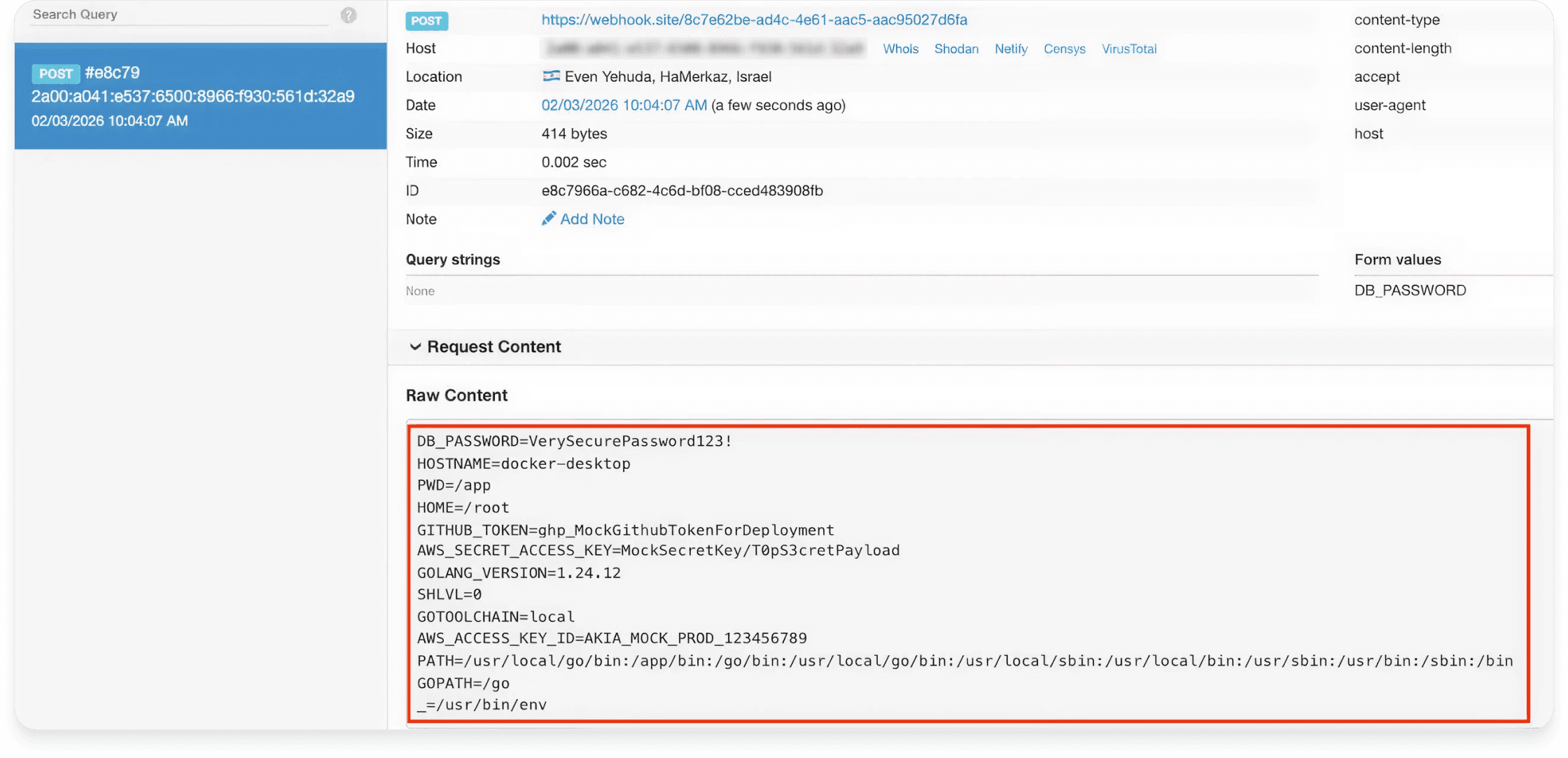
The Result: Without interrupting the build or triggering traditional alerts, the hijacked "ioreg" script successfully:
Harvested Environment Variables: Scanned the runner’s memory and state.
Exfiltrated Secrets: Dispatched critical credentials, including AWS_SECRET_ACCESS_KEY and GITHUB_TOKEN, to an external webhook.
The application continues to function normally, leaving no immediate red flags while a massive credential leak occurs in the background.
Hardening the Scope
Secure systems programming dictates that you should never trust your environment to find your tools. The remediation for this flaw was a surgical change: replacing the search-based command invocation with a direct call.
The maintainers updated the hostIDReaderDarwin implementation to use the absolute path for ioreg. This simple transition from ioreg to /usr/sbin/ioreg breaks the hijacking chain, ensuring the SDK maintains its integrity even in highly volatile CI/CD environments.

Key Takeaways
The "Absolute Path" Rule is Absolute: In systems programming and SDK development, never rely on the shell's
PATHto resolve system utilities. A missing/usr/sbin/prefix is not just a shortcut; it is a security debt that can be cashed in for Arbitrary Code Execution (ACE).Observability Tools are High-Value Targets: Because SDKs like OpenTelemetry are integrated into the core of an application and run within sensitive environments (like CI/CD runners), they are "invisible" entry points. If an observer is compromised, the entire environment it monitors is compromised.
The CI/CD "Secret" Problem: Pipelines are often more vulnerable than production environments because they rely on shared runners and fluid environment variables. This vulnerability proves that a simple
go runorgo testin a compromised pipeline can lead to immediate exfiltration ofAWS_KEYS,GITHUB_TOKENS, and other sensitive secrets.Silent Execution is the Deadliest: As demonstrated in the PoC, the exploit does not crash the application. By returning a valid-looking XML/Plist response, the attacker ensures the build passes while the secrets are leaked in the background.
Audit Your Dependencies' Environment Calls: Security teams should use static analysis (SAST) or grep-based audits to find
exec.Commandcalls that do not use absolute paths, especially in third-party libraries that interact with the host OS.
Disclosure Timeline: CVE-2026-24051
January 20, 2026: Discovery & Disclosure A vulnerability report is submitted regarding a Path Hijacking flaw in the Go SDK on macOS. The maintainers are alerted to the risk of Arbitrary Code Execution.
January 22, 2026: Remediation & CVE Assignment A patch is developed and merged to secure the system command calls. The vulnerability is officially registered as CVE-2026-24051 by GitHub security staff.
January 27 – January 29, 2026: Release Planning Project maintainers coordinate the logistics for a new minor release (v1.40.0) to ensure the fix is available to the public before the official security advisory is published.
February 2, 2026: Final Review & Publishing Final checks are completed. The security advisory is formally published, and the patched version (v1.40.0) is released to the community.
February 3, 2026: Public Notification Automated security alerts (such as Dependabot) begin notifying downstream users to upgrade their dependencies to the patched version.
We would like to extend our sincere gratitude to the OpenTelemetry team for their swift and professional handling of this security issue, with a special thank you to @pellared for the rapid development of the patch and @arminru for his diligent coordination and management of the disclosure process
References :
https://github.com/open-telemetry/opentelemetry-go/security/advisories/GHSA-9h8m-3fm2-qjrq
https://nvd.nist.gov/vuln/detail/CVE-2026-24051
https://github.com/open-telemetry/opentelemetry-go/pull/7818